
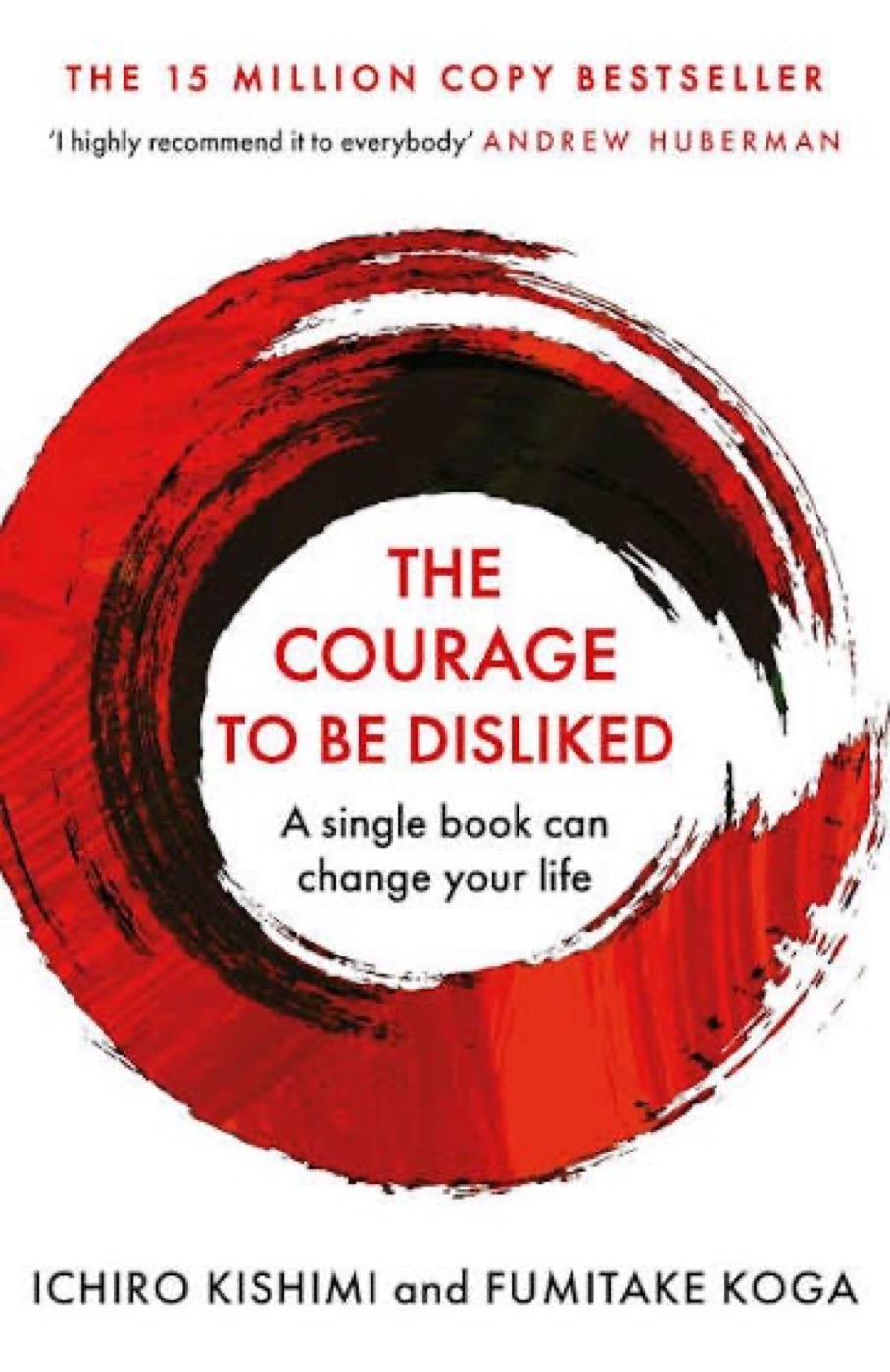
This week, our Monday Book Club started reading The Courage to Be Disliked
How much of our life is really determined by other people, and how much is still ours to choose?
What began as a discussion about courage and approval gradually moved into responsibility, family, self-worth, interpretation, expectations, love, and inner peace.
1. Freedom begins when we stop needing everyone’s approval
One of the first reflections was that being disliked is not really the goal.
The deeper idea is having enough courage to make choices that other people may not understand or approve of.
Starting a business. Choosing an unconventional career. Moving abroad. Leaving a familiar situation. Living differently from your family’s expectations.
The question becomes:
Can I still choose my life when the people around me disagree with my choice?
Perhaps freedom is not getting everyone to support us.
Perhaps freedom is no longer requiring their approval before we allow ourselves to live.
2. Taking responsibility is uncomfortable, but powerful
We spent a lot of time discussing the difference between being responsible for what happened to us and taking responsibility for what we do next.
It can be comfortable to remain inside a familiar story:
“This person made me unhappy.”
“My parents expect this from me.”
“My circumstances don’t allow me to change.”
We may not have chosen what happened to us, but if we stay inside that story forever, we also give up our ability to change what happens next.
The past may explain where we are, but it does not have to decide where we go.
At any moment, we still have choices about how we respond, what we change, what we accept, and what direction we take from here.
Taking responsibility is not about blaming ourselves for everything that has happened. It is about reclaiming our agency.
We have far more choice over the direction of our lives than we sometimes allow ourselves to believe.
3. We don’t experience an entirely objective world
Another idea that fascinated us was the role of interpretation.
Two people can experience the same event and give it completely different meanings.
Our upbringing, previous experiences, fears, expectations and beliefs all influence how we interpret what happens around us.
Someone looks at us strangely.
Was that person judging us?
Maybe.
Or maybe they were tired.
Maybe they were thinking about something completely unrelated.
Maybe our interpretation says as much about what we are carrying internally as it does about the other person.
This led to a useful practice:
Hold your interpretation a little more lightly.
Instead of immediately reacting, create space for other possible meanings.
4. We cannot control other people’s behaviour, but we can choose our response
This became one of the strongest themes of the evening.
We often carry expectations about how other people should behave.
Our parents should understand us.
Our colleagues should respect us.
Our friends should support our decisions.
Our partners should respond in a particular way.
When reality doesn’t match that expectation, disappointment, anger and resentment can appear.
But we cannot control another person’s behaviour.
What we can work on is our own response.
That doesn’t mean accepting harmful behaviour or having no boundaries.
It means understanding the separation between:
What is mine to take responsibility for?
and What belongs to the other person?
5. Sometimes changing a relationship starts with changing ourselves
Family relationships brought this idea to life.
Several people described how parents can continue relating to their adult children as though they were still children.
And interestingly, we sometimes continue responding to our parents from that old role too.
One participant shared how she started communicating more honestly with her mother about what she actually wanted from life, even when those choices contradicted her mother’s expectations.
The relationship didn’t transform overnight.
Old patterns still returned.
But something began changing when she changed how she showed up.
The important distinction was:
We don’t change ourselves in order to control the other person.
We change because our own behaviour is the part that belongs to us.
6. Your worth doesn’t come from your title
Our conversation also moved into career, status and self worth.
What happens when someone close to us seems to judge our choices because our career doesn’t fit their definition of success?
Are we worth more because we have a prestigious title?
Are we worth less because we choose an unconventional path?
If our self worth depends entirely on other people’s recognition, we remain vulnerable to every judgment around us.
The courage to be disliked therefore also requires something deeper:
the courage to define our own worth.
7. Treat people according to your values, not their reputation
One participant shared a beautiful example.
He knew someone whom other people had warned him about. Instead of automatically adopting their judgment, he decided to treat the person normally and respectfully until his own experience gave him a reason not to.
The person responded with respect.
It raised an interesting question:
How often do our expectations help create the very behaviour we expect?
Perhaps compassion doesn’t mean being naive.
It means allowing another human being to meet us without forcing them into a story we have already written about them.
8. The conversation eventually arrived at love
This became perhaps the most unexpected part of the evening.
If I love someone, is that love my responsibility?
And if they don’t love me back, is their response their responsibility?
We explored the uncomfortable possibility that love itself does not have to be transactional.
“I love you” does not automatically mean:
“Therefore, you owe me love in return.”
But this raised another important distinction.
Loving without demanding something in return does not mean giving endlessly without boundaries.
When we continuously give while secretly expecting the other person to eventually repay us emotionally, resentment can grow.
So we asked:
Do I actually love this person, or do I love how this person makes me feel about myself?
That question changed the conversation.
9. Love, attachment and self worth are not necessarily the same thing
If someone makes us feel attractive, important, successful or worthy, losing their attention can feel like losing part of ourselves.
But is that love?
Or are they temporarily filling something we haven’t yet learned to give ourselves?
Several people returned to the importance of self love and self worth.
When we are more fulfilled within ourselves, relationships can become less about dependency and more about mutual connection.
We can love another person without asking them to carry the entire responsibility for our sense of worth.
10. Protect your inner peace
Toward the end of the evening, someone offered an image I loved:
Treat your inner peace like a castle.
Other people will disagree with us.
They may misunderstand us.
They may dislike our decisions.
They may fail to give us the recognition, affection or approval we hoped for.
The goal isn’t to control all of that.
The work is to become increasingly clear about what belongs inside our responsibility and what doesn’t.
Perhaps that is what The Courage to Be Disliked is really pointing toward.
Not becoming cold.
Not ignoring other people.
Not deliberately trying to be disliked.
But developing enough inner freedom to say:
I can listen to you without surrendering my life to your opinion.
I can care about you without controlling your response.
I can love without making love a transaction.
I can acknowledge my past without allowing it to dictate my future.
And ultimately:
I can take responsibility for the life that is mine to live.
That may be one of the hardest forms of courage.
But it may also be one of the most liberating.