
Welcome to In the Making with Joanna Liu
For a long time, I believed something very simple. If I was strong enough, talented enough and determined enough, I could work almost anything out on my own.
It's an attractive belief. It makes us feel independent. It makes us feel safe. Nobody can let us down if we never needed them in the first place. And for a while, it even seems to work.
But life has slowly taught me something different. Sometimes all the talent in the world isn't enough. Not because the ability is missing. But because we haven't yet met the person, or found the place, that allows that ability to fully unfold.
Today I'd like to tell a story from Chinese history that I keep coming back to. It's about two people who were both, in their own way, stuck. And about what happened when they finally sat down in the same room.
A man who kept starting again
The year is 207. China is breaking apart. The old dynasty is collapsing, and warlords are fighting over what is left.
One of them is a man called Liu Bei. He is forty-seven years old, and he has been fighting for more than twenty years.
He is not a lazy man, and he is not an untalented one. People are drawn to him. Good soldiers follow him and stay loyal to him for life. And still, nothing holds.
He serves under one warlord, then another, then a third. Each time he believes he has finally found solid ground. Each time, the ground is gone a year or two later. At forty-seven, an age when most people of his time had long settled into whatever their life was going to be, he still had no land of his own.
What strikes me about this part of the story is how hard he was trying. This wasn't a man waiting for luck. He had energy, courage, ambition and a gift for people. In a way, the more he pushed, the more often he ran into a wall.
He had a great deal of force, and nowhere clear to send it.
A man who was waiting
Not far away, in a quiet place called Longzhong, lived a young man of twenty-seven. His name was Zhu GeLiang.
While the country was at war, he was farming. He ploughed his fields, he read, and he thought.
The few people who knew him said he had one of the finest strategic minds of his generation. He could look at a map of a broken country and see how the pieces might fit together again. But a strategy with nobody to carry it out is only a thought in a field.
So there they were. One man with fire, and no direction for it. One man with direction, and nowhere to use it. Both capable. Both unfinished. And neither of them could solve it alone, however hard they worked.
Three visits
That winter, Liu Bei heard about the young man in Longzhong. And he did something that must have cost him a little pride.
He was a commander, twenty years older, with a name people knew. Zhu GeLiang was a farmer nobody had heard of. Liu Bei went to see him anyway. The story says he had to go three times before the two of them finally sat down together.
I find that detail moving. He didn't send a messenger. He didn't wait to be approached. He went, and when it didn't work, he went again.
When they finally talked, Zhu GeLiang laid out a plan. Where to go first. What to take. Who to make peace with. How a man with no land could, step by step, come to hold a third of the country.
For the first time in twenty years, Liu Bei could see a road. And for the first time in his life, Zhu GeLiang had someone who would actually walk it.
What happened next took a little more than ten years. One province. Then another. Then a third. The man who had wandered for half his life became the emperor of one of the three kingdoms of China.
Not more effort, a missing half
When I think about this story, one question stays with me. Why did the first forty-seven years lead nowhere, and the next ten change everything?
Liu Bei didn't suddenly become more hard-working. He had always been hard-working. Zhu GeLiang didn't suddenly become more intelligent. He had always been intelligent. What changed was that they met.
And I think it's worth being precise about what the meeting did. They didn't simply add their strengths together.
Zhu GeLiang woke up something in Liu Bei that had been there all along but had never been used: the ability to think in decades instead of battles. Liu Bei woke up something in Zhu GeLiang too: the wish to step out of the field and risk his ideas in the real world.
Each of them became more of himself because the other was there.
That is different from help. Help is when someone carries part of our load. This is when someone's presence makes us able to do what we couldn't do before.
There is a very old picture for this in Chinese thought. Most people have seen it: a circle, half dark and half light, each half curving into the other. Yin and yang.
The I Ching, the book behind that picture, says something I find beautiful. Yin alone does not give birth. Yang alone does not grow.
Pure drive, with nothing to steady it, burns out or runs in circles. Pure reflection, with nothing to move it, stays in the field. Neither half is wrong. Neither half is weak. Each is simply half.
When the balance broke
The story has a later chapter, and I think it matters just as much.
Years afterwards, at the height of his power, Liu Bei lost a man who was like a brother to him. He was overcome by grief and anger, and he decided to go to war to avenge him. People around him advised against it. He went anyway.
For the first time in years, he acted as pure force again, without the steadying half. The campaign ended in a terrible defeat. Not long after, ill and close to the end of his life, he called Zhu GeLiang to his side and placed his son and his kingdom in his hands.
I don't read this as a story about a foolish man. I read it as a reminder that the balance between two people is alive. It isn't a contract that gets signed once.
The other person doesn't only encourage us. Sometimes they are the one who says, "wait." And a good partnership needs room for that too.
What this looks like for us
Most of us are not trying to found a kingdom. But I see a smaller version of this story all the time.
I meet people who are full of energy and ideas, who start five things and can't decide which one deserves them. I meet people who have thought about one idea for three years, who know every detail of it, and who have never shown it to anyone. I've been both of those people.
And when we work alone, we rarely notice which half is missing. We just notice that we're tired.
So we do the thing that seems logical. We work harder at the half we already have. The person with drive pushes more. The person who thinks, thinks more.
But the answer was never more of the same. The answer was sitting somewhere else, in another person, farming a field.
Two flowers
There's a picture I like to use when I talk about this. Two good friends are like two flowers. You water me. I water you. We both keep growing. And we don't drain each other.
That last line is the important one. This is not about finding someone to lean on until they are empty. It's not about one person giving and the other taking. Each brings their own energy. Each has their own work, their own roots. And each leaves the other a little more alive than before.
For me, this is what a good accountability partner is. Not someone who checks whether we did our tasks. Someone who is growing too, next to us, and whose growing makes ours easier.
Liu Bei and Zhu GeLiang didn't rescue each other. They watered each other.
Who we sit next to
If I take one thing from this story, it is this. Who we spend our days with is not a detail. It shapes what we believe is possible. It shapes which parts of us get used and which stay asleep.
We put so much care into our skills, our plans and our tools. We put much less care into the question of who is in the room while we work. And for many of us who work for ourselves, the honest answer is: nobody.
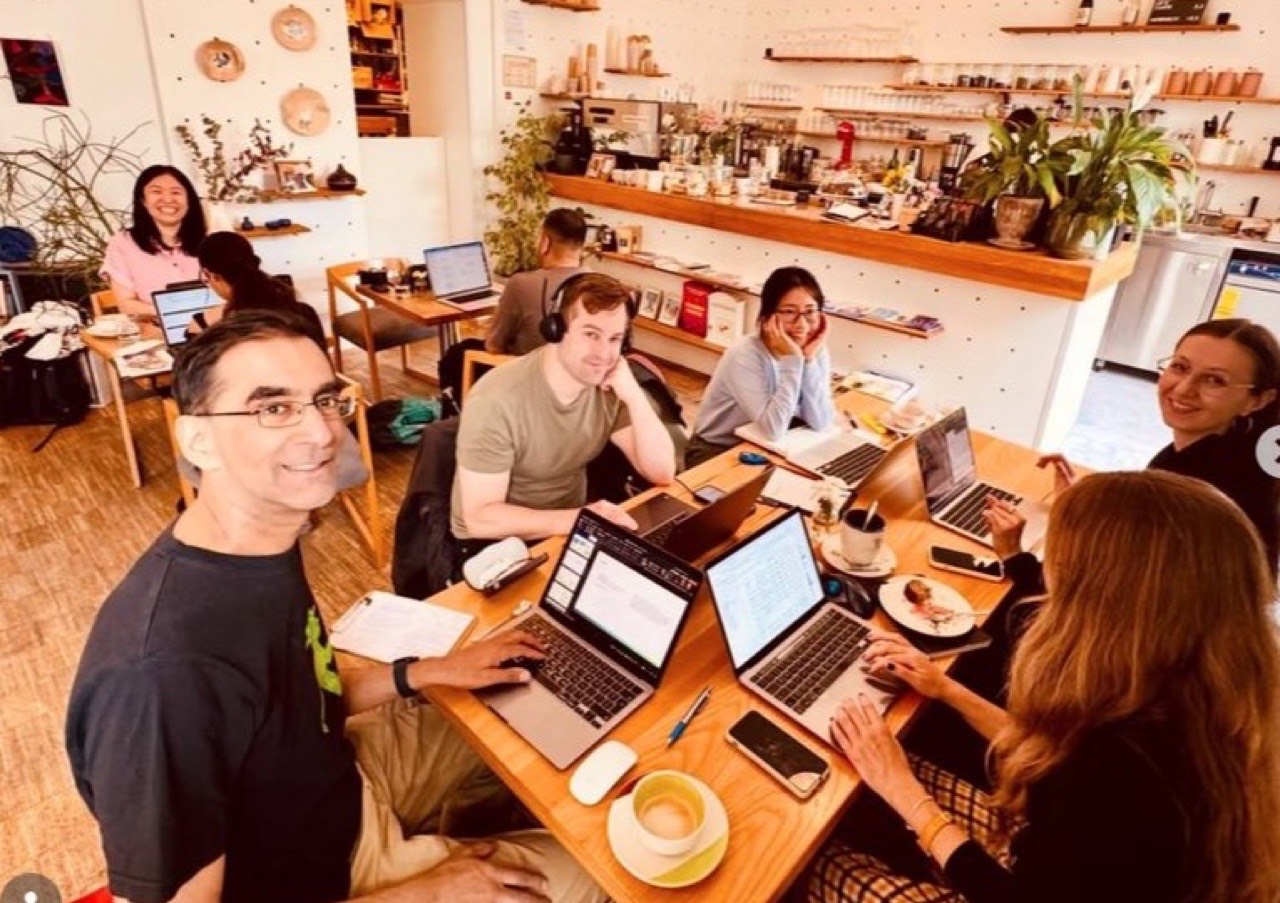
This is why I started NoCrastination. We put tables in places around Vienna. People bring their own work. In focus time, everyone works. In the breaks, we talk, and we really get to know the people next to us.
I can't tell anyone who they will meet there. Nobody can promise a co-founder, or a friend for life. Liu Bei didn't know what he would find in Longzhong either.
But I do know this much. The person who thinks the way we don't, the one who might one day become a co-founder, or a collaborator, or simply someone who makes us braver, cannot find us at the kitchen table. We have to be in a room.
And once we're in the room, we have to take part. Ask the person next to us what they're working on. Say out loud what we're stuck on. Ask the table a question.
That's the modern version of walking to Longzhong. And if the first table isn't the one, we go again. He went three times.
There is one more thing I love about that story. Liu Bei didn't wait for the meeting to happen. He made it happen. Anyone can do that too.
If there's no table near you, or not on the day you need one, you can host one. Pick a place, pick a time, and pull up the first chair yourself.
When you host a table, you pull up the first chair. And we work together. You bring the table. We bring our channels. If you want, we tell people about you and what you do. That's our part: making sure the table can be found.
Then we step back. Because what happens next is not about us. Someone you've never met pulls up the next chair. And what grows between those chairs belongs to the people sitting on them. That's where the two flowers are.
Before we finish
Before we finish, I'd like to leave you with two questions.
The first one. Which half are you? Are you the one with fire, who starts and pushes and moves, and sometimes isn't sure where it is all going? Or are you the one with the map, who sees clearly, and sometimes waits a little too long in the field? There's no better half. It simply helps to know.
The second one. Who waters you, and whom do you water? Think of the last time you left a conversation with more energy than you came with. Who was that? And when did you last sit next to them?
Perhaps we are all a little unfinished when we begin. We have our strengths and our blind spots, our ambitions and our gaps. And perhaps some of the detours and closed doors along the way are not proof that we aren't enough. Perhaps they are part of how we find the people who complete the picture.
Becoming ourselves is not always a solo journey.
So this week, don't work alone. Pull up a chair.
I'm Joanna.
Thank you for listening to In the Making with Joanna Liu.
I'll see you next time.